

Jolly Roger That
What's going on around the world?

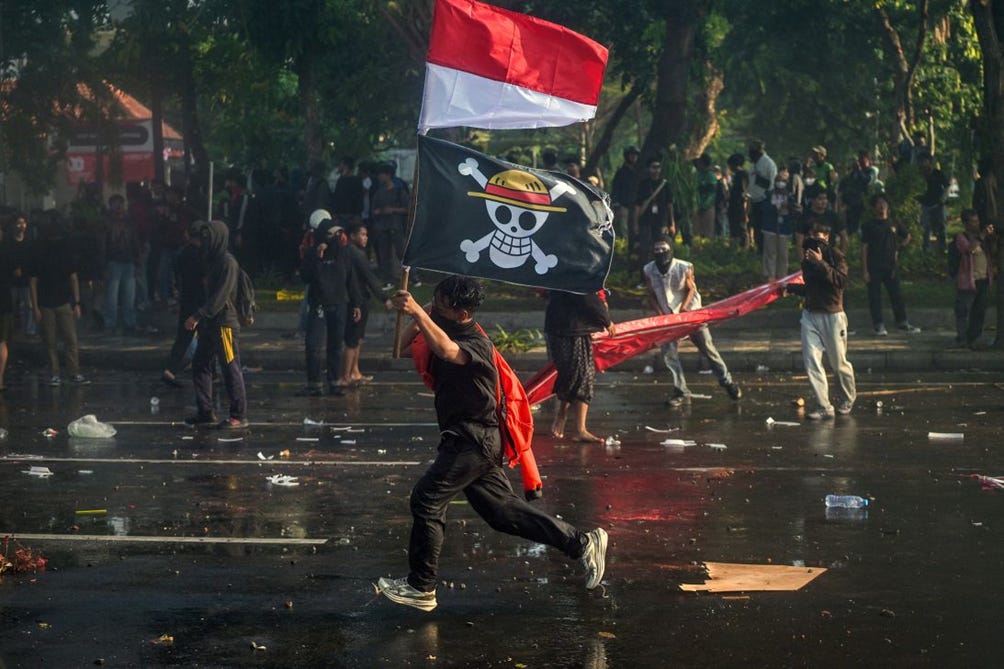
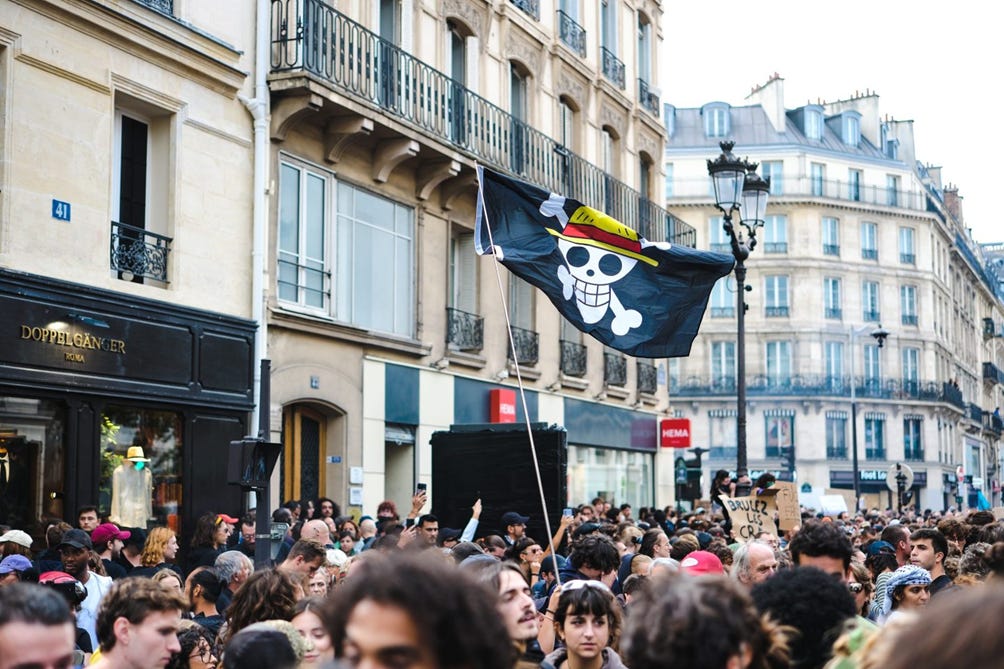
From Paris and Rome to Jakarta and New York, a weird vessel has begun to appear in protest squares around the world.
In Indonesia, for instance, the flag was placed outside homes and attached to motorbikes, cars, and trucks.
In Kathmandu, Nepal, where public fury erupted in September 2025, the same banner was hung on the gilded gates of the palace housing parliament as a public response to politicians’ privileges.
The ‘Jolly Roger’ of the Straw Hat Pirates emerged as the defining symbol amid flames engulfing the gates of Singha Durbar.
The disruption ultimately forced the prime minister to resign, paving the way for Supreme Court Justice Karki, renowned for her anti-corruption stance, to be sworn in as interim prime minister.
I see the spread of the flag as a vivid example of how Gen Z is redefining the cultural language of dissent, crossing borders to become a unifying symbol and rallying cry for youth-led protest movements worldwide.
Liberty Symbol
One Piece was born alongside Gen Z, created in 1997 by Japanese mangaka Eiichiro Oda.
The franchise has since expanded into a long-running anime series, live-action adaptations, and a global industry worth more than US$20 billion, with merchandise licensing alone earning roughly US$720 million annually for Bandai Namco.
This immense cultural and commercial reach has cemented One Piece as – together with Dragon Ball – the most renowned and influential anime and manga of all time.
In a nutshell One Piece tells the story of Monkey D. Luffy and his crew, the Straw Hat Pirates, as they defy a corrupt world government in pursuit of freedom and adventure.
As far as I am concerned, the Jolly Riger embodies Luffy’s unyielding fight for liberty against political systems rife with corruption, inequality, and authoritarian excess.
It is 1977 when, disillusioned by the earth’s warlike drift, Daiba Tadashi jumps on the Arcadia, Captain Harlock’s spaceship.
In doing so, he overturns the pacifist and ecological ideals of its creator, Matsumoto Leiji – ideals that have been co-opted by the reactionary right, which embodies a nostalgic romanticism yearning for the eternal return of a retrograde and misoneistic political creed.
Instead, for example, Pepe the Frog – originally a right-wing online meme – was adopted by pro-democracy protesters in Hong Kong in 2019.
Similarly, the three-finger salute from The Hunger Games film series has become a symbol of resistance for young pro-democracy demonstrators in Thailand and for opponents of the 2021 military coup in Myanmar.
The flag has also appeared increasingly at protests in recent years, such as at a ‘Free Palestine’ rally in Indonesia in 2023 and at a pro-Palestinian demonstration in New York later that same year.
It was in Indonesia, in August 2025, that the government condemned the display of the flags as threats to national unity, while demonstrators viewed them as legitimate expressions of political discontent over corruption and growing inequality.
Whereas, In Nepal, the flag became a symbol of anger over youth unemployment and the ostentatious displays of wealth by political dynasties on social media.
The speed with which Jolly Roger flag spreads across borders reflects the digital upbringing of Gen Z.
The rise of ‘geek’ or otaku culture – once a niche, now mainstream – has redefined what cultural capital means for younger generations.
In the past, movements spread through sit-ins, marches, and hunger strikes. Today, it is symbols and visual references drawn from global culture that travel fastest.
The flag’s journey – from the streets of Asia to protests in Italy, after reemerging in Israel during humanitarian flotilla missions supporting aid to Palestine – illustrates how cultural symbols migrate and evolve in the global era.
What began as a pop icon rooted in a manga fantasy of freedom and camaraderie has transformed into a transnational emblem of resistance.
The Straw Hat Pirates’ flag – originally created to represent friendship, adventure, and personal freedom – has been adopted by populist movements claiming to wage a vague fight against the establishment.
Thus, it has been improperly wielded as a political banner, distorted to convey meanings that have little to do with the narrative universe envisioned by Eiichiro Oda.
One Piece is a shōnen battle manga, published in Weekly Shōnen Jump, a magazine primarily aimed at teenagers and young boys. Its themes and narratives – such as a sense of justice, loyalty, and personal growth – are not part of any ideological or political agenda.
Therefore, interpreting One Piece as an allegory of socialism or class struggle is a distortion of its intended morality.
Eiichiro Oda, as a Japanese author, does not have a political background or consciousness that can be equated with Western paradigms of socialism or communism.
Japan has never fully internalized these doctrines; its political and cultural history has been shaped by other tensions, such as the Meiji Restoration, militarism, and postwar reconstruction.
Thus, it is a mistake to ascribe a “Marxist” or “revolutionary” perspective to Oda. His notion of justice is strictly narrative rather than ideological.
Justice is intended as an ethical tension. The protagonists resist authority not as a symbol of a ruling class or an unfair economic system, but because it manifests moral corruption and the misuse of power.
Oda crafts a world in which conflict is not defined by struggles between lawmakers and electorate.
Rather, it represents the narrative anarchism typical of shōnen manga, intended to cultivate empathy rather than to present a concrete political model or echo the rhetoric of mass media.
The Straw Hat crew is neither a activist party nor a social revolution: it is a metaphor for individual freedom.
Ideological appropriation goes beyond simple misinterpretation. Ultimately, conflating the Jolly Roger with a populist manifesto overlooks the divide between art and propaganda.
It exemplifies the failure of critical reading when confronted with the desire to claim a symbol for oneself.